
ART, WHATEVER IT TAKES

Since the early pandemic in 2020, Rome Art Program has conducted a series of interviews, “Art, Whatever It Takes.”
Artists, Art Critics, and Art Historians living in Italy, the U.S., and U.K., share their insights during these powerful times.
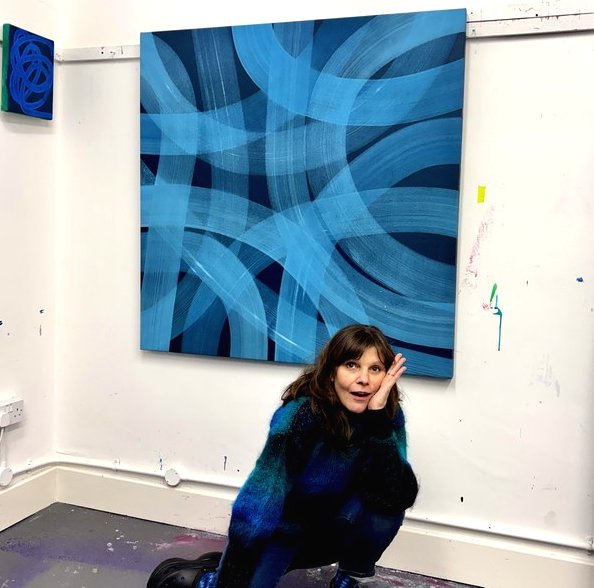
Interview with Lucy Soni

Lucy Soni, born Kent, 1973. Lives and works in London.  She graduated BA Painting, Chelsea College of Art London and Turps Art School; she is represented by Voltz Clarke Gallery NYC, USA.   Soni’s practice is rooted in painting, with an interest in chaos and control, colour, light, and the urge to mark make.  This plays out through a hand-made process, with out the use of tape, producing large-scale, intensely colourful paintings.   Immersed in complexity & producing a sort of control out of chaos, Soni’s paintings are exercises in accuracy, seeking to celebrate colour & form.  Lucy exhibited widely and her work can be found in public and private collections in the UK, Hong Kong and the USA.  Soni’s curatorial project Why Don’t You…? HQ is an ongoing project in her home, taking part in Art Licks Weekend 2015 – 2019. She co-curates BLINK, an artist-led platfom, set up in 2021. She currently has a solo show at Voltzclarke NYC, 2026. 

RomeArtPrpgram: What is your definition of art today?

Lucy Soni: Here, there and everywhere.

RAP: Art is dynamic and regenerates itself... How does it change and how has it changed us?

Lucy: This is a huge question, I don’t think i can answer it!

RAP: What role does art play today?

Lucy: The same roles it’s always played but more accessible and commodified.

RAP: What would you recommend to an emerging artist today?

Lucy: Keep going. Do it yourself. Build a supportive network. Most artists will (if they are lucky) spend their whole career ‘emerging’. ‘Arriving’ is often the death of art.

RAP: How have new technologies & media culture changed art today?.. made it better or worse? ...challenges?

Lucy: They are tools. Artists will find ways to play with and subvert them. Things have the potential to be gained and lost from their use.

RAP: Understanding, interpreting, and then possibly judging a work of art; which is the right way to approach a work of art?

Lucy: Just look at it. Try looking for a whole minute, the rest will follow.

RAP: What is the real role of academies and art schools today? What can artists learn from them today?

Lucy: Art schools at best give students time and space to learn and develop. Your peers are as important as your tutors. At worst art schools are businesses that prioritise money over space and learning.

RAP: How do art galleries and museums position themselves today, and, in your opinion, how should they?

Lucy: I think (in the UK) they are more accessible, people can see a lot of free incredible art here. In my opinion that’s a good thing!

RAP: ...will art save us? 

Lucy: Art can sustain us but I’m not sure any one thing can save us.

@lucysonistudio