ART, WHATEVER IT TAKES

Since the early pandemic in 2020, Rome Art Program has conducted a series of interviews, “Art, Whatever It Takes.”
Artists, Art Critics, and Art Historians living in Italy, the U.S., and U.K., share their insights during these powerful times.
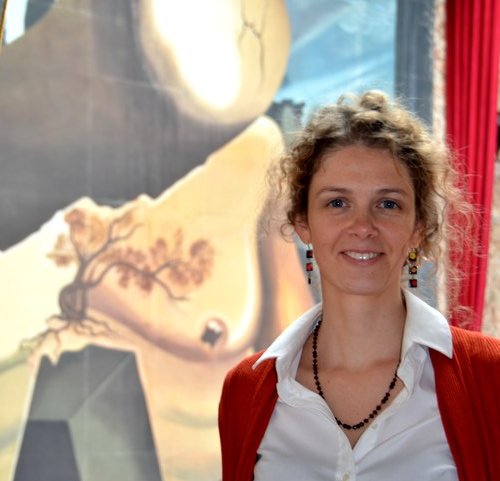
Interview with Lucia Moni

After earning a master’s degree in Art History from the University of Pisa, with a thesis on Salvador Dalí’s audiovisual production, Lucia Moni has been coordinator at the Centre for Dalinian Studies since 2009.  She is currently senior curator at the Fundació Gala-Salvador Dalí and responsible for the Foundation’s audiovisual archive, overseeing audiovisual projects, including the most recent documentaries on Dalí’s life.  Lucia has also participated in the curatorship of various exhibitions including ‘Dalí, Shakespeare, Visconti’ (Gala Dalí Castle, Púbol, 2016), ‘Io Dalí’ (Palazzo delle Arti, Naples, and Castello Ursino, Catania, 2018), ‘My Favourite Painters: Velázquez, Vermeer and Raphael’ (Dalí Theatre-Museum, Figueres, 2024), and ‘Dalí. Revolution and Tradition’ (Museo del Corso, Rome, 2025).  Lucia is the author of specialised writings on Dalí’s relationship with Italy and classicism, particularly focusing on the painter’s admiration for Renaissance artists. She co-curated the first chronology of Dalí in Italy for the ‘Dalí: an artist, a genius’ exhibition at the Vittoriano in Rome (Skira, 2012).

RomeArtProgram: When and how was your institution founded and what does it do?

Lucia Moni: The Fundació Gala-Salvador Dalí was established by the artist himself in 1983. It is a private entity with a clear mission: to promote, encourage, disseminate, enhance, and defend the Dalí universe worldwide. Based in Figueres, the Foundation is more than a cultural institution: it is a living reflection of Salvador Dalí's desire to ensure the continuity of his artistic, intellectual and spiritual legacy. The Fundació Gala-Salvador Dalí manages the Dalí Theatre-Museum in Figueres, the Gala Dalí Castle in Púbol, and the Salvador Dalí House in Portlligat.

RAP: Is there a project or event of which you are particularly proud?

Lucia: The last exhibition we organized in Rome, at the Museo del Corso – Palazzo Cipolla, was a particularly significant experience for us. Entitled "Dalí. Revolution and Tradition" the exhibition explored the dialogue between Salvador Dalí and the great masters of the past, as well as his contemporary Pablo Picasso, offering the public a new perspective on the artist. The main challenge was to create a unique narrative, specifically conceived for this collaboration with the Fondazione Roma; Montse Aguer, Director of the Dalí Museums, was entrusted with the scientific direction. Carme Ruiz and I were responsible for curating the exhibition.

RAP: What is your definition of art today?

Lucia: Art is a universal treasure, a source of emotional well-being and vital knowledge. It is a necessity. It is a magical force that opens, expands and integrates the mind and heart.

RAP: Art is dynamic and regenerates itself...how does it change, and how did it change us?

Lucia: Art is constantly changing; it is never static. It looks to the past, reflects the present and anticipates the future, as Salvador Dalí did throughout his artistic journey. The beauty of art lies in its ability to forge connections in space and time, transforming both those who observe it and those who experience it.

RAP: When (and how) did you understand that art was becoming important in your life?

Lucia: Ever since I was a child, I have been drawn to all forms of creative expression, such as art, literature, music, poetry, cinema and the books I found in my home library. At school, my favourite class was art education. Despite being very demanding, the teacher always managed to stimulate my curiosity. I particularly remember the museum visits with my class: seeing a work of art in person for the first time after only having seen it in books was a completely different sensory experience, which strengthened my desire to delve deeper into art.
So, when I chose to study art history at university, I realised that I wanted to make art central to my life, both personally and professionally.

RAP: What role does art play today?

Lucia: Lucia: Today art reflects the challenges and contradictions of our time, stimulating critical thinking and fostering dialogue. It invites us to view reality from new perspectives. As a powerful tool for personal and collective expression, art is capable of evoking emotion, inspiring action and bringing about change.

RAP: Which is the real role of academies and art schools today? What can artists learn from these institutions?

Lucia: Academies and art schools continue to play a vital role in artist training. They provide the methodical approach and discipline that are essential for developing a personal style. As Salvador Dalí argued, art is born not only from inspiration, but also from constant, rigorous work: 'one must work, work, work.' Furthermore, academies are places of sharing, interpersonal encounters and examination. It is precisely these relationships that must be maintained more than ever. Otherwise, technology will eventually prevail over the creative depth of human beings, which would mark the end of art.

RAP: How do Art Galleries and Museums position themselves today, and, in your opinion, how should they?

Lucia: Art galleries and museums must keep pace with the times, respond to the needs of visitors, and foster authentic dialogue between artwork and audience. They should promote creativity and inclusivity by offering meaningful and innovative experiences that engage the senses, stimulate the mind and awaken curiosity. They are responsible for designing exhibitions that broaden visitors' minds, excite them and teach them something new. Visitors should leave feeling as if something inside them has started to vibrate.

RAP: …will art save us?

Lucia: Art alone cannot save us; salvation depends on us, and art is one of the most powerful tools we have.

Lucia Moni

https://www.linkedin.com/in/luciamoni/