
ART, WHATEVER IT TAKES

Since the early pandemic in 2020, Rome Art Program has conducted a series of interviews, “Art, Whatever It Takes.”
Artists, Art Critics, and Art Historians living in Italy, the U.S., and U.K., share their insights during these powerful times.
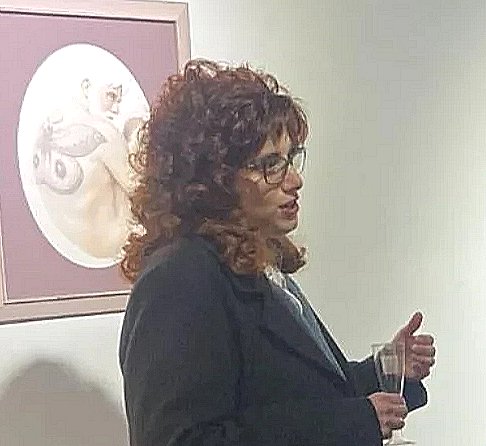
Interview with Giulia Aversente

Giulia Aversente was born in Albano Laziale (Rome). She graduated in Art History from Sapienza University of Rome.  She began expressing her passion for drawing and painting by attending a Roman training school for comic artists, and later refined her knowledge in the workshop of Emiliano Alfonsi, her master.  Giulia’s research  is based on a contemporary vision, with clear references to the Renaissance tradition, investigating the spiritual sphere manifested in bodies understood as matter.  Her attention to detail and pictorial refinement lead the viewer toward a profound exploration of beauty.

RomeArtProgram: What is your definition of “Art” today?

Giulia Aversente: In my view, art is a silent refuge from the chaos of an unstable life, a voice that speaks through different languages, but with a shared and universal energy.

RAP: Art is dynamic and regenerates itself… how does it change and how has it changed us?

Giulia: As a product of humanity, art follows its destiny of evolution & progress, finding new ways to express itself  and responding to the expressive needs of a given historical period. Change is an essential part of art, as it is connected to the human experience.

RAP: When (and how) did you understand that art was becoming important in your life?

Giulia: My love for art began at a very young age and gradually deepened over time. Studying Art History, I began to feel the need to devote myself to artistic practice. After graduating, I embarked on a formative path with a master artist, in his workshop.

RAP: What role does art play today?

Giulia: Today, art is the voice of peoples and cultures, responding to the need to tell the story of our world. From prehistoric cave pictograms to the present, humanity continues to contemplate the unknown beyond itself. The role of art is certainly to reveal and to express the transformations of a reality that moves fast and is shaken by challenging situations.

RAP: Are there still traditional figures such as collectors, muses, mecenate and patrons, in today's art and society interaction model?

Giulia: These important figures still exist, but today art certainly represents an umbrella term that embraces diverse new forms and languages, which have altered certain traditional dynamics by opening the doors to a varied audience of enthusiasts.

RAP: How have the new technologies and media culture changed art today, improving or worsening it? ...challenges?

Giulia: The positive side of technology is its ability to bring art closer to more people through a simple screen, in an accessible and universal way. At the same time, its negative side lies in contributing to the creation of an overstimulated society. The challenge for the future is certainly to reconcile fragile human reality with an increasingly pressing digital world.

RAP: Which is the real role of academies and art schools today? What can artists learn from these institutions today?

Giulia: Personally, I did not attend an Academy or Art School. Instead, according to my life needs, I chose to train in a master’s workshop. However, I believe these institutions are interesting places of exchange and study for artistic growth and research.

RAP: How do Art Galleries & Museums position themselves today, and, in your opinion, how should they?

Giulia: Galleries and Museums allow people to fully experience art by observing works in person. Over time, however, their predominant role has been overshadowed by the rise of social media and online sales platforms. Today it’s very important for these institutions to develop new awareness, and open themselves to digital computerized future.

RAP: …will art save us?

Giulia: Art has already saved us. It has given the world beauty and truth and will always continue to do so; it’s inherent in human nature to express one’s inner narrative.

@giuliaaversentepainter